Plants Japan Googles the Most: a Wikipedia pageview ranking — and why #1 is Giant Hogweed
What plant do you think Japanese people are most curious about?
Cherry blossoms? Roses? Hydrangeas? It's tempting to guess. But when we actually pulled the numbers, the answer was nothing like that.
For this article we took the 656 species registered in Plantour and aggregated their Japanese Wikipedia pageviews over the past 12 months (April 2025 – March 2026). The resulting ranking exposes three distinct motivations that drive how Japanese readers engage with plants.
🔗 Plantour: https://plantour.app/
First, the Top 10
656 species, 26.5 million pageviews in total. Here are the leaders.
| Rank | Species | Family | 12-month views |
|---|---|---|---|
| 1 | Giant Hogweed | Apiaceae | 293,032 |
| 2 | Red Spider Lily | Amaryllidaceae | 261,035 |
| 3 | Lilac | Oleaceae | 231,958 |
| 4 | Oleander | Apocynaceae | 186,619 |
| 5 | Avocado | Lauraceae | 166,046 |
| 6 | Potato | Solanaceae | 160,062 |
| 7 | Maize | Poaceae | 150,664 |
| 8 | Coriander | Apiaceae | 149,327 |
| 9 | Açaí | Arecaceae | 140,486 |
| 10 | Ginkgo | Ginkgoaceae | 138,147 |
Cherry blossom (Yoshino cherry) sits at rank 14 with 132,724 views. Rose doesn't even make the Top 30. The number-one slot went to a Caucasian native that has barely naturalized in Japan: Giant Hogweed.
Why?
Question 1: Why is Giant Hogweed #1?
Giant Hogweed (Heracleum mantegazzianum) is a 3–5 m perennial in the carrot family, native to the Caucasus. In Europe and North America it's classified as an invasive species and a target for eradication. Sap containing furocoumarins reacts with sunlight on contact with skin, causing severe phytophotodermatitis (chemical burns) — earning it the title "one of the world's most dangerous plants." It is barely established in Japan.
Yet it leads the Japanese Wikipedia pageview chart by a mile (293,032).
The monthly breakdown explains everything.
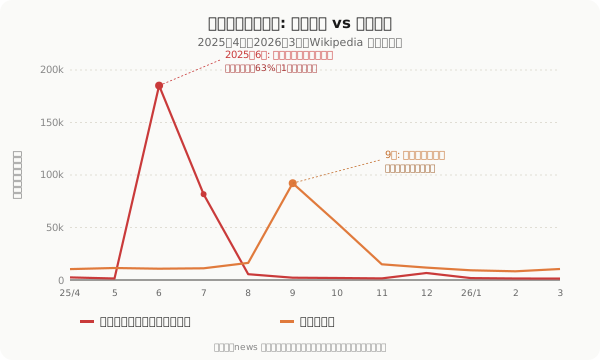
185,099 of those views landed in June 2025 alone — that's 63% of the annual total in a single month. The slowest month (March 2026, 1,369 views) is 135 times smaller than the peak. That's not "consistently popular." That's a single news-driven spike.
🧠 A trap with annual rankings A one-month viral surge looks identical to "evergreen popularity" in an annual total. Giant Hogweed's #1 spot is built almost entirely on the credit it earned during one June news cycle.
For comparison, the #2 species — Red Spider Lily — peaks in September (92,160) but the ratio between peak and trough is only 11×. That's the shape of a plant with sustained interest year-round, riding a seasonal swell rather than a single splash.
A detour: why is Lilac at #3? — pop-music distortion
Did you spot the other oddity in the Top 10? Lilac at #3 (231,958 views).
Lilac is a deciduous shrub in the olive family — common in northern Japan (Hokkaidō, Nagano) but not really a household plant in central or southwestern Honshū. It outranking hydrangea (#12) or fragrant olive (#15) doesn't add up from a plant-distribution or familiarity standpoint.
The monthly breakdown deepens the mystery:
| Month | views |
|---|---|
| 2025-04 | 33,213 |
| 2025-05 | 37,171 (peak) |
| 2025-09 | 13,399 |
| 2025-12 | 9,832 |
| 2026-01 | 29,224 ← !? |
| 2026-02 | 9,140 |
The May peak makes botanical sense — that's lilac's blooming season. But 29,224 views in January 2026 is impossible to explain biologically. Who is searching for a leafless deciduous shrub in the dead of winter?
The likely answer: the Japanese band Mrs. GREEN APPLE released a song called "ライラック" (Lilac) in April 2024 as the opening theme of the anime Forgotten Battery. The January spike almost certainly reflects year-end music shows (Japan's "Kōhaku Uta Gassen" airs Dec 31), where re-performances of the song send curious viewers to Wikipedia: "Lilac... wait, what does that even mean?"
🧠 "Wikipedia pageviews = botanical interest" doesn't hold If hogweed at #1 is news-driven, lilac at #3 is music-driven. Plants that share a name with a popular song, novel, or anime character get pulled up by interest that has nothing to do with the plant itself. Two different shapes of "external bazz" — same effect on the chart.
So the ranking we're about to dissect isn't only a window onto plant culture: it's also a window onto pop culture in general, with both flowing through Wikipedia's search logs.
Question 2: What about the other Top 30 entries? — "Eat them, admire them, fear them"
Removing the news-driven outlier, the remaining Top 30 sorts cleanly into three motivations.
🍴 "Eat" — food crops and produce
14 of the Top 30 are edible: avocado, potato, maize, coriander, açaí, sweet potato, tomato, Manchurian wild rice, apple, banana, konjac, common fig, strawberry, garlic.
Nearly half the list is stuff you can buy at the supermarket. People search "what plant is this exactly?" while shopping or cooking, and that traffic is steady all year.
🌸 "Admire" — ornamentals and seasonal markers
Lilac, hydrangea, fragrant olive, Yoshino cherry, flowering dogwood, camellia, sunflower, ginkgo — the trees and herbs Japanese readers see and recognize at specific times of year. Garden, street tree, and park stalwarts.
☠️ "Fear" — toxic, invasive, "should I touch this?"
Giant hogweed, oleander, red spider lily, aconite, opium poppy, tall goldenrod, Japanese knotweed. Roughly a quarter of the Top 30 — anxiety-driven searches about whether something is poisonous or invasive.
🧠 Eat > admire > fear, in that order Loosely the Top 30 splits into roughly 14 edibles : 8 ornamentals : 7 dangerous : 1 other. To Japanese readers, plants are first food, then scenery, then threats.
Question 3: The shape of the ranking — long tail and Zipf's law
Now the statistics. Plot rank against pageviews on a log-log scale and you get this:
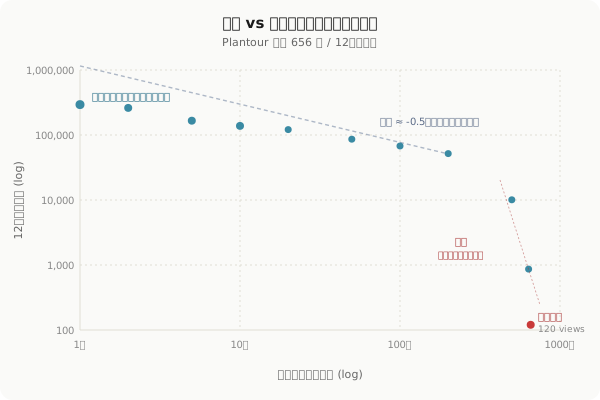
The points trace an almost-straight line. That's the fingerprint of a Zipfian distribution.
🧠 What is Zipf's law? A distribution where the r-th-ranked value is proportional to 1 / rα. Word frequency in any language, city populations, book sales, YouTube view counts — the way human attention concentrates almost always takes this shape. On log-log axes, the relationship appears as a downward-sloping straight line. The slope α tells you how concentrated the distribution is.
For Plantour's plant data, the slope α is roughly 0.5 — gentler than the typical Zipfian α ≈ 1. In other words, popularity is less top-heavy than language or city size: there's a broader long tail.
Concentration in numbers
| Range | Species | Total views | Share |
|---|---|---|---|
| Top 10 | 10 | 1,892,069 | 7.1% |
| Top 50 | 50 | 6,164,283 | 23.2% |
| Top 100 | 100 | 9,948,729 | 37.5% |
| Remaining 556 | 556 | 16,590,296 | 62.5% |
The Top 100 holds 37.5% of all pageviews; the remaining 556 species — the long tail — together hold 62.5%. That's less skewed than the famous 80/20 Pareto rule. Reader attention is more dispersed than you'd expect.
This is actually heartening: "mid-tier" species like multiflora rose, common cattail, and weeping willow — the ones sitting just inside the Top 100 — still draw real readers.
Question 4: The tail end — monotypic families and obscure ferns
Where there's a long tail, there's a tip. Here are the bottom 5 species:
| Rank | Species | views | What is it? |
|---|---|---|---|
| 656 | Costus | 120 | Tropical ginger relative; Costaceae is a small family |
| 655 | Hongū fern | 181 | Streamside fern of Honshū to Kyūshū |
| 654 | Mizuhakobe | 433 | Tiny annual on rice-paddy edges |
| 653 | Tape grass | 448 | Aquatic plant in the Aponogetonaceae |
| 652 | Mitsude-uraboshi | 456 | Small epiphytic fern on rocks and trunks |
What ties them together? Strong scientific value, near-zero public name recognition.
- Costus, Hongū fern, and Aponogetonaceae are textbook examples of families most readers couldn't even name
- Mizuhakobe and tape grass survive only in specific wetland habitats
- Mitsude-uraboshi is a small epiphyte — easy to walk past
Wikipedia pageviews measure what humans talk about. That's a completely different axis from biological diversity or evolutionary significance. Costus has 120 views because Japanese readers haven't heard of the family — but Costus itself is alive and well in tropical South America and Southeast Asia.
🧠 Plantour's editorial stance Plantour deliberately includes this end of the long tail. Monotypic families, habitat-restricted endemics, obscure ferns — open the taxonomy view and you'll see them scattered all across the phylogenetic tree, painting a different "map of plants" than any popularity chart could.
Takeaways: ranking is a mirror of culture
What 656 species' pageviews reveal:
- #1 is decided by viral spikes: Giant Hogweed's lead is built on a single news cycle in June 2025. Don't trust annual totals at face value
- Three motivations dominate: food, ornament, fear. To Japanese readers plants are mainly edible objects
- The distribution is Zipfian and long-tailed: 7% in Top 10, 37.5% in Top 100, 62.5% in the remaining 556 — surprisingly dispersed
- The tail is monotypic families and habitat specialists: pageviews tell you nothing about biology. Plantour curates this tail intentionally
Next time you open Plantour, try the identification key to bump into a mid-tier species you've never noticed, or browse the taxonomy view to see how the long tail spreads across the tree of life. The world behind the ranking is much bigger than the ranking itself.
Coming next
Next week, with the May "edible-wild-greens" season in mind: bracken, royal fern, and field horsetail — ancient plants that don't bother with flowers. Where the Dandelion War covered evolution-in-progress, this one rewinds the clock by 300 million years.
🔗 Plantour: https://plantour.app/
Data sources and methodology
- Data: Japanese Wikipedia Pageview API
- Window: April 2025 – March 2026 (12 months)
- Sample: 656 species in Plantour with recorded
popularitysnapshots - wikiTitle: each species's resolved Wikipedia article title (redirects followed). Species occasionally share an article (e.g., flowering dogwood and Cornus florida point to the same page).
Source data lives in src/data/plants.ts under each species's popularity field in the Plantour repo.
Image credits
- Cover photo "Flowers of Lycoris radiata and paddy fields near Kanzaki Station": Soramimi / Wikimedia Commons / CC BY-SA 4.0
