Burdock🌿
Arctium lappa
ゴボウ
A biennial in Asteraceae native to Eurasia. An unusual vegetable whose root is eaten only in Japan, Korea, and Taiwan, used in kinpira gobo, tonjiru (pork miso soup), and takikomi gohan (mixed rice). Rich in dietary fiber and said to improve gut health. Characterized by its distinctive earthy aroma and crisp texture.
Identification Points
- ✓Large taproot exceeding 1 m in length
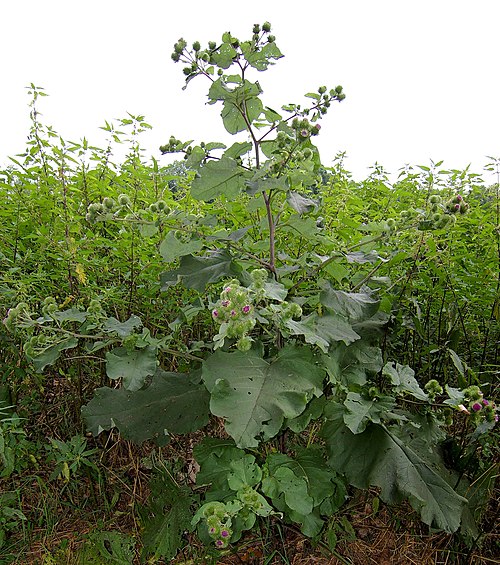
- ✓Leaves are large and heart-shaped with dense white woolly hairs on the underside
- ✓Purple capitula (flower heads) resembling thistles, with spiny involucral bracts
- ✓Achenes have hooked spines that catch on clothing (bur)
Habitat
Fields, farmland, roadsides, and wastelands
Season
Spring sowing: April–May, harvest: autumn–winter
Morphological TraitsAI-estimated, needs verification
Leaf arrangement
Alternate
Leaf type
Simple
Venation
Pinnate
Leaf margin
Serrate
Leaf shape
Cordate
Growth form
Herb
Petal count
5 petals
Petal fusion
Fused
Habitat
Cultivated
Ovary position
Inferior
Stamen count
1-2
Phylogenetic Positionキク科 →
Phylogenetic Position
Angiosperms > Eudicots > Core eudicots > Asterales > Asteraceae
Divergence Era
Late Cretaceous to Paleogene (approx. 80–70 million years ago)
Evolution Notes
The hooked spines on Asteraceae fruits are an evolutionary adaptation for epizoochory (animal-attachment dispersal). This hooking mechanism is said to have inspired the invention of Velcro.
View on evolution timeline →Sources & References
AI-generated, needs verification